


Cabinet hardware is one of the smallest decisions in a kitchen renovation, and one of the most consequential. It’s tempting to treat it as an afterthought, something to choose in the final week once the cabinets are already hung and the countertops are already set. But hardware is what your hand touches every single day. It’s also one of the fastest ways to date a kitchen, or to make one feel like it will still look right in fifteen years.
The kitchens that feel timeless are rarely the ones with the most expensive hardware. They’re the ones where the hardware was chosen with the same intention as everything else in the room, including exactly where nickel, brass, and bronze belong, and why we almost never use more than two finishes in a single room. Here’s how we think about it.
The Most Important Decision: Finish Before Style
Before you fall in love with a knob shape or a pull profile, the finish needs to be settled first. In our kitchens, each finish tends to have a specific job: brass on cabinet hardware, polished nickel on plumbing fixtures, and bronze reserved for the moments we want a piece to disappear entirely.
Brass (Cabinet Hardware)
Brass, particularly unlacquered or aged brass, is where we start with almost every set of cabinet hardware. It develops a soft, living patina over time, deepening and shifting unevenly the way old hardware always has. It’s not for someone who wants everything to look brand new forever. It’s for someone who wants their kitchen to look better in ten years than it does today.
Polished Nickel (Plumbing Fixtures)
Polished nickel is our favorite for plumbing fixtures, hands down. It has the warmth of brass without competing with it, and it holds a soft, reflective shine without ever tipping into the coldness of chrome. Where brass is where we reach for cabinet hardware, polished nickel is where we go for faucets and fixtures, it lets the fixture’s shape do the talking while still catching the light beautifully. It’s timeless in a way that doesn’t date, and it pairs easily with almost anything else happening in the room.
A quick distinction worth making here: when we say nickel, we mean polished, not brushed. Brushed nickel has become the finish of nearly every builder-grade fixture on the market, and it reads that way no matter how nice the rest of the kitchen is. If a finish in the nickel family is going into one of our kitchens, it’s polished.
Oil-Rubbed Bronze
Oil-rubbed bronze earns its place when we don’t want the hardware or fixture to add anything, no extra warmth, no extra shine, no extra color story. It’s the finish to reach for when the goal is for a piece to disappear into the architecture and let its shape be the only thing you notice. Where polished nickel and brass bring a bit of sheen and warmth to a room, bronze recedes. We choose it when we want form over finish.
Each finish has a job. Brass warms up the cabinetry, polished nickel gives fixtures their shine without going cold, and bronze steps back so a shape can speak for itself.
Knobs vs. Pulls: When to Use Each
Once the finish is settled, the next decision is where knobs belong and where pulls take over, and this is where our approach is a little more particular than most.
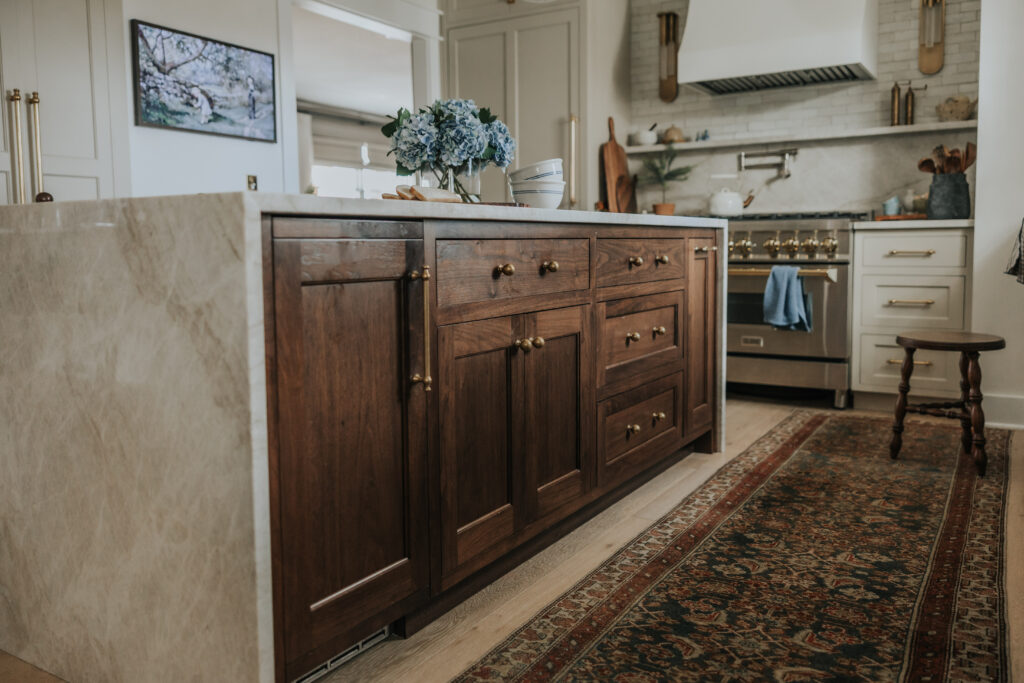
We use knobs on nearly everything, upper cabinets, lower cabinets, and most drawers included. Partly this is a style preference, we like drawers more than cabinet doors, and partly it’s because a knob softens cabinetry that’s already fairly linear and square. A round knob breaks up all those straight lines in a way a pull can’t.
Pulls are reserved for a smaller, more specific list: panel-ready appliances, a pantry door, a trash pull-out. We’ll also use a pull on a drawer occasionally, but only if the pull style itself has some curve or softness to it, something that still breaks up the geometry rather than reinforcing it.
On the smallest cabinet doors, the little ones tucked above a hood or beside a window, we skip knobs and pulls altogether in favor of a latch. It’s a detail that reads as more considered than hardware scaled too large for the door it’s on.
For a stack of drawers, our go-to configuration is two knobs on the top drawer and two pulls across the bottom two drawers, giving the stack a sense of proportion from top to bottom rather than repeating the same hardware all the way down.
Knobs do most of the work in our kitchens because they soften a lot of straight lines. Pulls step in only where function calls for it, appliances, pantries, and the occasional curved drawer pull, and the smallest doors get a latch instead of either.
How (and When) to Mix Hardware Finishes
Mixing finishes in a kitchen isn’t a mistake, but it does need boundaries. Our rule: two finishes per room, no more. Hardware and lighting live in one finish family, and plumbing fixtures live in a second. We never bring a third hardware finish into the mix.
That doesn’t mean the hardware and lighting need to be an exact match. A brass knob and a brass pendant don’t have to share the exact same sheen, what matters is that the undertones and the overall color story agree. Warm stays with warm. If the hardware leans yellow-gold, the lighting should too, even if the specific brass tone varies slightly piece to piece.
Once those two finishes are locked in, that’s where the mixing stops, and where color and pattern take over instead. We’d rather layer interest through the soft furnishings, a patterned roman shade, a colorful runner, than add a third metal into the room.
Two finishes, always: one for hardware and lighting together, one for plumbing. Beyond that, let color and pattern do the layering instead of more metal.
Our Favorite Finishes for a Timeless Kitchen
If we had to name the finishes we return to again and again, it’s unlacquered or aged brass for cabinet hardware and lighting, polished nickel for plumbing fixtures, and oil-rubbed bronze on the occasions we want a piece to disappear rather than shine. Brushed nickel doesn’t make the list, in our eyes, it reads as builder-grade no matter the kitchen it’s in. All three of our go-to finishes age well, and none of them will look like a trend a decade from now.
A Real Example: Hardware in One of Our Recent Kitchens
In a recent kitchen renovation, we used unlacquered brass knobs throughout the upper and lower cabinetry, a brass pendant overhead in the same warm undertone, and polished nickel for the faucet and pot filler. On the bank of drawers beside the range, we used two knobs on the top drawer and pulls with a soft curve across the two below it, giving the stack a sense of proportion instead of repeating the same hardware top to bottom. Two finishes, one softening detail in the drawer stack, and nothing left to compete with the marble or the millwork.
The best kitchen cabinet hardware isn’t the hardware you notice first. It’s the hardware that quietly makes everything else in the kitchen look intentional, and keeps looking that way for years.
Frequently Asked Questions About Kitchen Cabinet Hardware
Does cabinet hardware need to match throughout the kitchen? Yes, the hardware finish should stay consistent throughout a kitchen. It doesn’t need to be an exact sheen match to the lighting, but the undertone and color story should agree. Where hardware tends to differ is more in shape, knobs versus pulls, than in finish.
What’s the most timeless hardware finish? We come back to unlacquered or aged brass for cabinetry and lighting, and polished nickel for plumbing fixtures, because both develop character or hold their shine well over time. Brushed nickel is the one finish we avoid entirely, it’s become shorthand for builder-grade in the designer world.
Should I choose knobs or pulls for my cabinets? We lean toward knobs for nearly every cabinet door and most drawers, they soften linear cabinetry in a way pulls don’t. Pulls are best saved for appliances, pantry doors, and any drawer where the pull itself has enough curve to keep softening the look. The smallest cabinet doors skip both in favor of a latch.
How many hardware finishes should I use in one kitchen? Two, at most. Hardware and lighting in one finish family, plumbing fixtures in a second. Anything beyond that starts to compete rather than complement, and it’s better to introduce more visual interest through color and pattern in the soft furnishings instead.
Ready to bring timeless details into your own kitchen? Browse our portfolio for inspiration, or reach out about our in-person and virtual interior design services.
