


Window treatments are one of the last decisions made in most rooms, and one of the first things a room is missing without. It’s easy to think of them as purely functional, something to block light or add privacy, but the treatment you choose says as much about a room’s personality as the furniture in it. A room with tailored drapery reads differently than a room with a relaxed roman shade, even if everything else in the space is identical.
For a cottage home, the goal isn’t formality. It’s warmth, texture, and a little bit of imperfection, treatments that feel gathered over time rather than engineered all at once. Here’s how we think about the personality each style brings to a room.
Drapery
Floor-length drapery is the most formal of the window treatment options, but in a cottage home, formal doesn’t mean stiff. A linen drape in a soft, slightly rumpled fabric, pooling gently at the floor, brings softness and height to a room without feeling precious. Drapery is the treatment we reach for in primary bedrooms and living rooms, anywhere we want a window to feel like a finished architectural moment rather than an afterthought.
Roman Shades
Roman shades are the workhorse of cottage window treatments, tailored enough to feel intentional, relaxed enough to never feel formal. A linen or cotton roman shade in a soft neutral or a small-scale print is one of the most versatile choices in a home, equally at home in a kitchen, a bathroom, or layered underneath drapery in a living room. They bring a sense of order to a window without losing warmth.
Shutters
Shutters bring an architectural, almost permanent quality to a window. They’re the treatment we lean on most in kitchens and bathrooms, rooms where moisture and practicality matter, but they also work beautifully in a study or a mudroom, anywhere we want a window to feel like part of the millwork rather than a soft furnishing. Shutters read more tailored and less cozy than fabric treatments, so we tend to reserve them for the more utilitarian rooms of a cottage home rather than the primary living spaces.
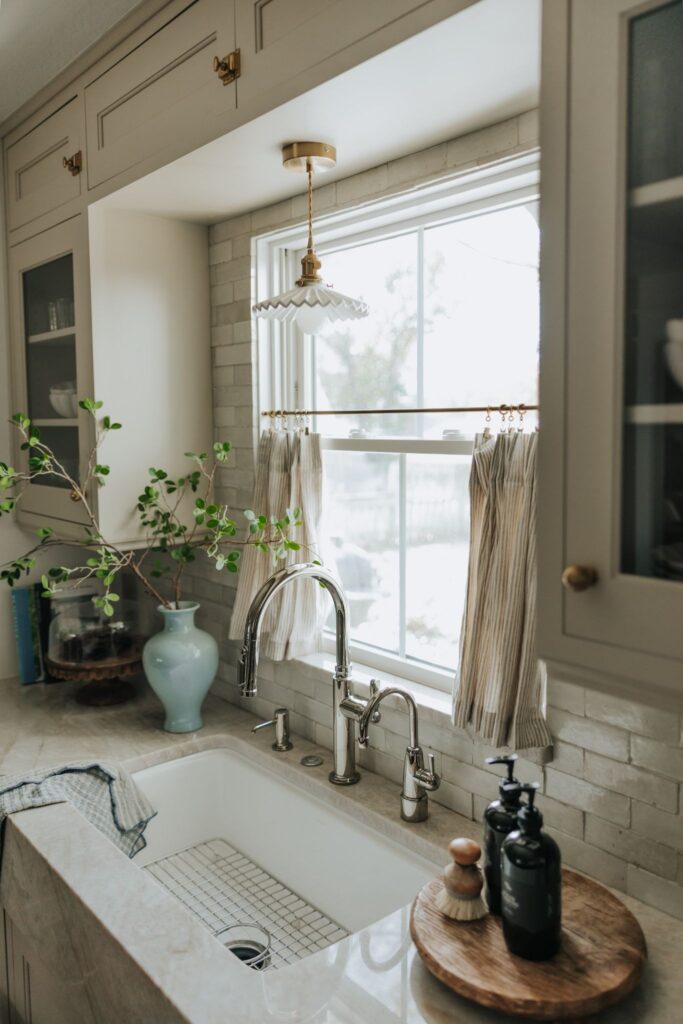
Cafe Curtains
Cafe curtains, hung to cover just the lower half of a window, are one of our favorite details for smaller, cottage-scale windows, especially in a kitchen or breakfast nook. They let in light and view from the top of the window while still offering privacy where it matters, and there’s something inherently charming and unpretentious about them that fits the cottage aesthetic better than almost any other treatment.
Every window treatment brings a different mood into a room: drapery for softness and height, roman shades for tailored ease, shutters for architectural permanence, cafe curtains for unpretentious charm. The right choice depends on the personality you want that specific room to have.
Choosing the Right Treatment for a Cottage Home
Above all, the treatments that work best in cottage interior design have some give to them, texture, imperfection, natural fiber. A crisp, perfectly tailored roman shade in a synthetic fabric will always read more formal and less warm than the same shade in a slightly nubby linen. When in doubt, choose the treatment with a little softness built in. It’s the difference between a window that looks styled and one that looks lived in.
A Real Example: Layering Treatments in a Recent Cottage Living Room
In a recent living room project, we layered a soft linen drapery in a warm cream behind a woven roman shade in a small-scale check, allowing the homeowners to close the shade for daytime privacy while keeping the drapery purely for softness and framing. The combination gave the window three different textures without a single one of them feeling formal. That layering, function in one treatment, warmth in the other, is one of our favorite ways to bring personality into a room through the windows alone.
The right window treatment does more than block light. It sets the tone for how a room feels the moment you walk in, and in a cottage home, that tone should always lean warm.
Frequently Asked Questions About Window Treatments
Do I need drapery and a roman shade, or just one? It depends on the room. A single treatment is often enough for a smaller or more utilitarian space, but layering drapery over a roman shade in a primary living space or bedroom gives you both function and softness, and it tends to be what makes a window feel most finished.
What window treatment works best for privacy without losing light? A roman shade or a cafe curtain, both let you control privacy at exactly the level you need without covering the entire window. A roman shade can be raised partway, and a cafe curtain only ever covers the lower half by design.
Are shutters too formal for a cottage-style home? Not necessarily, it depends on the room. We tend to use shutters in kitchens, bathrooms, and mudrooms, where their practicality and architectural quality work in the room’s favor, and reserve softer fabric treatments for the primary living and sleeping spaces.
How do I choose a window treatment that still feels cozy and not overly tailored? Look for natural fibers with some texture and imperfection, linen, cotton, a nubby weave, rather than anything crisp or synthetic. Softness in the fabric itself does more to set a cozy tone than the style of the treatment.
Ready to find the right window treatments for your own home? Browse our portfolio for inspiration, or reach out about our in-person and virtual interior design services.
